On this page
A GMA pallet is the standard North American pallet: 48 × 40 in (1,219 × 1,016 mm), according to Mecalux. The name comes from the trade group that standardised the size. If a buyer, carrier or retailer tells you to “use GMA pallets”, that footprint is what they almost always mean. GMA is a size convention, not a certification: it says nothing about wood species, board count or load rating. The rest of this page covers what to confirm.
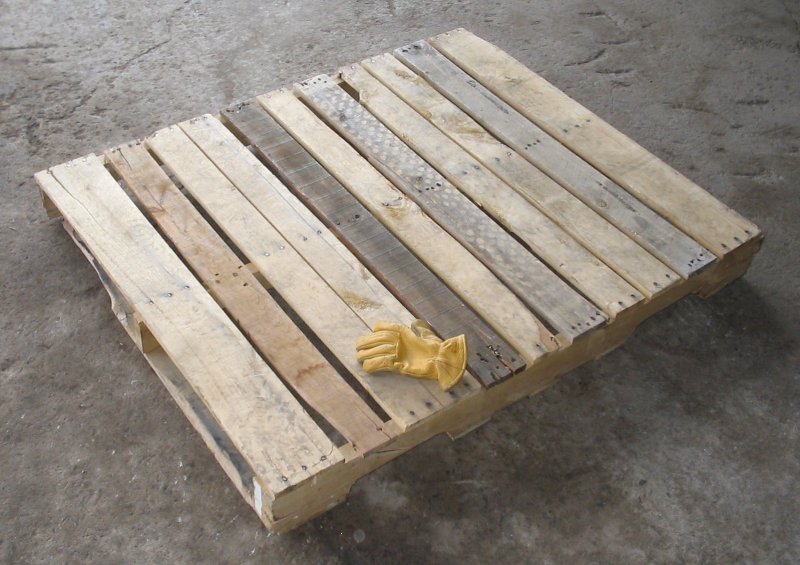

What GMA stands for
GMA stood for Grocery Manufacturers Association, which relaunched as the Consumer Brands Association in 2020 (Wikipedia). The pallet kept the old initials, which is why you still see “GMA” on spec sheets and purchase orders.
Wikipedia’s Pallet article says it is the most commonly used size by far and accounts for 30% of all new wood pallets produced in the United States, and that ISO lists the same footprint among its six standard sizes. Mecalux says the format was adopted to streamline the movement of goods. Our interpretation: a shared footprint lets a manufacturer, distributor and store stack, rack and truck the same pallet without re-palletising. For freight planning, pallets per trailer shows how this size fits, and the pallet calculator shows how many boxes fit on it.
Size, entry and construction
Footprint. 48 × 40 in (1,219 × 1,016 mm). Sources do not write the two numbers in the same order: Mecalux writes 48 × 40, while Wikipedia’s North American table lists the grocery size as 40 × 48 and puts 48 × 40 against military and cement use. Rehrig Pacific names its plastic version a “40 x 48 GMA” pallet. They describe the same rectangle, so always state which dimension is the fork-entry side rather than relying on the order.
Entry and construction. Mecalux describes 4-way pallets as allowing fork entry from all four sides, and two-way pallets as accessible from two opposite sides only. It says stringer pallets are the most popular type and that, by and large, stringer models are 2-way and block pallets are 4-way; 4-way stringer pallets do exist but are less common. The GMA footprint is built both ways, in wood and in plastic, so the name alone does not settle the entry type. Confirm it with the supplier.
Height and weight. The size fixes length and width only. Mecalux gives a typical height of 5.5–6 in (140–150 mm) and a typical unloaded wood weight of 33–49 lb (15–22 kg). One plastic model on Rehrig Pacific’s site lists 5.63 in and 47 lb. Height and weight depend on the lumber, the number of deckboards, the material and moisture, so use these as a range, not a spec. See how much a pallet weighs for what changes the figure.
“GMA”, “standard” and “grade A/B”
“GMA” and “standard” usually just mean the 48 × 40 footprint. “Grade A” and “Grade B” are trade labels for recycled pallets, not part of the size. One recycler describes a Grade A (#1) pallet as having original stringers with no repairs, and a clean look, and a Grade B (#2) pallet as “structurally sound” but repaired (Repackify). This is a trade convention, not a formal standard, so ask a seller for their criteria in writing: how many repairs are allowed, new or used, and what load it is rated for.
How it compares with Euro pallets
| Pallet | Size | Where it is used |
|---|---|---|
| GMA | 48 × 40 in (1,219 × 1,016 mm) | North America |
| Euro pallet | 1,200 × 800 mm | Europe |
| EUR 2 | 1,200 × 1,000 mm | Europe |
EUR sizes from Wikipedia, “Pallet”. For every size side by side, see the pallet sizes table; Euro pallet dimensions covers the EUR family.
A GMA pallet is not interchangeable with a standard Euro pallet: it is longer in both directions. The EUR 2 is much closer: it is only about 19 mm shorter and 16 mm narrower than a GMA pallet, so the two are easy to mistake for each other, but they are not interchangeable in racking or on a trailer. ISO lists several footprints, including 48 × 40 and 1,200 × 800 mm. If you ship to or from Europe, confirm which pallet the receiving warehouse expects before you buy.
What to ask a supplier
Figures vary; confirm with the supplier. Before ordering “GMA pallets”, get these in writing (no prices here, since they change by region and grade):
- Dimensions. Length, width and overall height, and which side is the fork-entry side.
- Entry type. 2-way or 4-way.
- Load rating. Ask for static, dynamic and rack ratings separately; they are different tests, not names for one number. Wood ratings vary with grade, species and board count, and this page gives no wood benchmark, so compare quotes on the same test basis. For scale only, one plastic Rehrig Pacific model lists a static rating of 7,200 lb, a dynamic rating of 4,200 lb and a 2 in edge rack rating of 2,400 lb. Do not treat those as typical for wood.
- ISPM 15 stamp. Wood pallets crossing most international borders need the mark. Wikipedia says, as of November 9, 2026, that the HT code means heat treatment to a minimum of 56 °C for at least 30 minutes. USDA APHIS says Canada and the United States exempt wood packaging made from wood originating in the continental US or Canada, but the import documents must carry an origin statement. Check the destination country’s plant-protection authority.
- New or recycled. New, repaired or remanufactured, and who graded it.
To turn a pallet size into a load plan, the pallet calculator and pallets-per-trailer table take it from here.
Sources
- Mecalux, GMA pallet: size, entry types, stringer and block entry, construction, height and weight ranges.
- Repackify, pallet grades: Grade A and B descriptions.
- Wikipedia, Pallet: production share, ISO footprint, EUR sizes, orientation in the North American table.
- Wikipedia, Consumer Brands Association: former name and relaunch.
- Rehrig Pacific, 40 x 48 GMA Rackable 2400 pallet: one plastic model’s height, weight and load ratings.
- Wikipedia, ISPM 15: HT mark.
- USDA APHIS, wood packaging material: US–Canada exemption and origin statement.
Last checked 9 Nov 2026. GMA is a de facto size, so put any wood, board and load requirements in your own purchase order. Edited by PalletSizes.com editorial; report a wrong figure via Contact.