On this page
The 463L master pallet measures 88 × 108 in overall, weighs about 290 lb empty and is rated for 10,000 lb of cargo. It is the US Air Force’s standard air cargo pallet. It is not a 48 × 40 in ground pallet, and the two are not interchangeable. Most airline flights use different pallets, covered below.
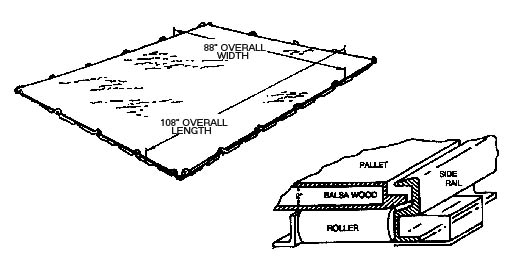

463L master pallet specifications
| Spec | Value | Source |
|---|---|---|
| Overall size | 88 × 108 in | 463lpallet.com, Wikipedia |
| Usable area | 84 × 104 in | 463lpallet.com, Wikipedia |
| Thickness | 2¼ in | Wikipedia |
| Empty weight (tare) | 290 lb | 463lpallet.com, Wikipedia |
| Maximum load | 10,000 lb (rated at 8 g) | 463lpallet.com, Wikipedia |
Keep cargo inside the 84 × 104 in usable area (the 88 × 108 in overall size includes the rails) and under the aircraft’s height limit. The 10,000 lb rating is a maximum at 8 g. Wikipedia adds that with two side nets and a top net the empty weight rises to 355 lb, and that 22 tie-down rings surround the edge, each rated at 7,500 lb. Count the nets in your tare weight if you are working out a gross weight.
Sources label the 88 in side as width or length; the pallet is the same either way, so say which side you mean to a loader. Construction is a balsa wood core with an aluminum skin. The figures here come from a supplier site and Wikipedia, not the military specification, so confirm anything contractual against the specification.
Why air pallets differ from 48 × 40
A standard North American ground pallet is 48 × 40 in, per Mecalux. It is sized for trucks, racks and forklifts. The 463L is the US Air Force’s main cargo pallet and also fits many Civil Reserve Air Fleet civilian cargo aircraft, so you may meet it on charter or CRAF flights. A shared footprint on the ground lets a warehouse, trailer and store handle the same pallet. In the air, the size is set by the aircraft and its loading system instead.
For a rough sense of scale only: the 463L usable area of 84 × 104 in is 8,736 sq in, while 48 × 40 in is 1,920 sq in, so the usable area is about 4.5 ground pallets. That ignores the rails and how loads actually stack, so it is not a fit calculation. The pallet sizes table lists the ground sizes side by side.
If you are sending 48 × 40 pallets by air, give the airline or forwarder the loaded length, width, height and weight of each one, and ask how it will be built up for the flight.
Commercial air pallets and ULDs
Airlines mostly use IATA unit load devices (ULDs). Wikipedia’s Unit load device article describes a ULD as a container used to load luggage, freight and mail on wide-body aircraft. Two common commercial pallets are the PMC and the PAG. Vietnam Airlines publishes these figures on its ULD specification page:
| Pallet | Base size | Tare (with net) | Max gross weight | Aircraft |
|---|---|---|---|---|
| PMC | 125 × 96 in | 120 kg | 15,000 lb (6,800 kg) | B777/B787/A350/A330 |
| PAG | 125 × 88 in | 115 kg | 15,000 lb (6,800 kg) | B777/B787/A350/A330 |
The airline notes that maximum gross weight depends on the position loaded in the aircraft, per its weight and balance manual. Figures are for Vietnam Airlines and its listed aircraft; other airlines may differ. For scale, a PMC base is 125 × 96 = 12,000 sq in, against 9,504 sq in for the 463L. The page gives no contour or height limit, and those depend on the deck and aircraft, so ask your forwarder or the airline for them for the flight you are booked on. ULDs also include enclosed containers, which this page does not cover.
Before you ship by air
- Get the airline’s limits first. Height, contour and gross weight depend on the aircraft, not on the pallet alone.
- Measure and weigh the loaded pallet, including overhang (see how much a pallet weighs). The cubic feet calculator gives the volume if the carrier asks for it.
- Ask how the airline charges. Carriers set their own rules for weight and volume. If you are used to ground freight, the freight class calculator is a ground-shipping estimate and the airline’s own rule takes precedence.
Paperwork: the air waybill
Whatever pallet it travels on, an air shipment moves under an air waybill. The explainer What Is an Air Waybill (AWB)? Meaning, Number & Example describes it as the contract between shipper and airline, a receipt for the goods and a tracking reference. That site is run by the same owner as this one, as disclosed on the About page.
Sources
- 463lpallet.com: overall size, tare weight and capacity (supplier site).
- Wikipedia, 463L master pallet: size, usable area, thickness, weights, load conditions, tie-down rings, construction, CRAF use. Figures are secondary-source; the military specification governs.
- Mecalux, GMA pallet: 48 × 40 in size.
- Wikipedia, Unit load device: ULD definition.
- Vietnam Airlines, ULD specification: PMC and PAG size, tare, gross weight, aircraft.
- a-w-b.com, What Is an Air Waybill (AWB)?: air waybill explainer (same owner).
Last checked 9 Nov 2026. Edited by PalletSizes.com editorial; report a wrong figure via Contact.