On this page
The standard Euro pallet, EUR 1, measures 1,200 × 800 mm, which is 47.24 × 31.50 in. Its height is 144 mm (5.67 in). Three related sizes, EUR 2, EUR 3 and EUR 6, share the family name. All four are in the table below, in millimetres and inches.
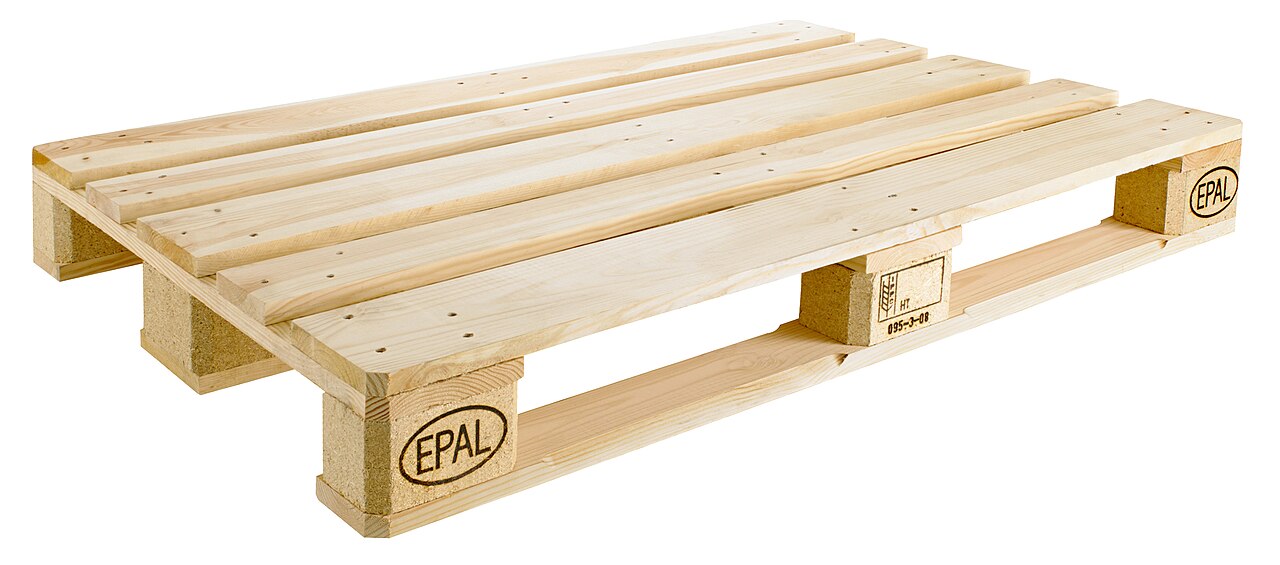

Euro pallet sizes in mm and inches
Each row gives length × width, with the long side first. Millimetres are as listed by Wikipedia, “Pallet”; the inch figures here are the same sizes converted at exactly 25.4 mm per inch, rounded to 2 decimals.
| Type | Length × width (mm) | Length × width (in) | Height |
|---|---|---|---|
| EUR 1 (EUR) | 1,200 × 800 | 47.24 × 31.50 | 144 mm (5.67 in) |
| EUR 2 | 1,200 × 1,000 | 47.24 × 39.37 | 144 mm (5.67 in) |
| EUR 3 | 1,000 × 1,200 | 39.37 × 47.24 | 144 mm (5.67 in) |
| EUR 6 | 800 × 600 | 31.50 × 23.62 | 144 mm (5.67 in) |
The EUR 1 size and its 144 mm height are also given by Container Exchanger and prologistik. Container Exchanger also lists EUR 3 at the size in the table. These figures come from secondary sources, so confirm them with EPAL or your pallet maker before you order.
Which one is the Euro pallet?
When a supplier or buyer says “Euro pallet” with no number, they mean EUR 1, the 1,200 × 800 mm size. EUR 6 is half of it, a 800 × 600 mm pallet that Wikipedia lists as half the size of the EUR pallet. EUR 2 is 1,200 × 1,000 mm, and EUR 3 is listed as 1,000 × 1,200 mm, the same two sides in the other order.
Sources are not consistent about EUR 3. The table in Wikipedia’s “Pallet” article and Container Exchanger list it as 1,000 × 1,200 mm, while the text of Wikipedia’s EUR-pallet article says EUR 2 and EUR 3 are “both 1,200 mm × 1,000 mm”. The footprint is the same either way; if the board direction matters to you, ask the supplier for a drawing.
EUR, EPAL and ISO: what each word tells you
These three terms get used as if they were interchangeable. They are not quite.
- EUR and EPAL. “EUR” is the pallet type. EPAL, which prologistik says stands for “European Pallet Association”, is the licensed brand and quality scheme: Wikipedia’s EUR-pallet article says the EPAL and EUR logos may only be used by licensees of that organization. A pallet can be EUR-sized without being EPAL-licensed, so a size match alone does not show it is a licensed pallet. If you need licensed pallets, ask the supplier for EPAL-marked ones and confirm the marks with the pallet maker or EPAL.
- ISO is a separate standards system. ISO 6780 is the international standard for pallet footprints. It includes 1,200 × 800 mm (EUR 1), 1,200 × 1,000 mm (EUR 2) and 1,219 × 1,016 mm (the North American 48 × 40 in) (sizemarker). The 800 × 600 mm EUR 6 is not among the footprints that list gives.
In practice: ask for the footprint in millimetres, and ask separately whether you need EPAL-branded pallets.
Height, weight and load rating
The 144 mm height is the figure for all four rows in Wikipedia’s table. For EUR 1, Container Exchanger says it “accounts for the deck boards and nine wooden blocks that form the base”, and gives the same height in inches rounded to one decimal (5.7 in). The 5.67 in in the table is the exact conversion.
Weight and load figures below cover EUR 1 only. For the other three sizes, ask the pallet maker.
- Empty weight, EUR 1. Wikipedia’s “Pallet” article and prologistik both give 20–25 kg. Container Exchanger says approximately 25 kg. Wood, moisture and build all move the number. See how much a pallet weighs for how to handle this.
- Load rating, EUR 1. Roughly 1,500 kg when moved (dynamic load, Container Exchanger), from 1,000 kg in racking to 4,000 kg in static storage (prologistik). Confirm the rating for your use with the pallet maker.
Why the EUR 1 is not a 48 × 40 pallet
The two are different sizes that happen to be in the same range. The North American pallet is 48 × 40 in, which Wikipedia gives as 1,219 × 1,016 mm. The EUR 1 is 1,200 × 800 mm, so it is a little shorter and much narrower.
Worked comparison: 48 in is 1,219.2 mm, so the EUR 1’s 1,200 mm length is 19.2 mm (0.76 in) shorter. 40 in is 1,016 mm, so its 800 mm width is 216 mm (8.50 in) narrower.
The closest Euro size to 48 × 40 in is EUR 2, at 1,200 × 1,000 mm (47.24 × 39.37 in). Even so, a US pallet in a Euro-sized space, or the reverse, will not sit flush. For every size side by side, including a size finder, use the pallet sizes chart on the home page. For the North American pallet itself, see the GMA pallet guide.
What it means if you ship from or to the US
Goods built around a 48 × 40 in pallet do not pack the same way on a 1,200 × 800 mm one, and the answer changes with the carton size. Rather than rely on a rule of thumb, run your own numbers:
- The pallet calculator lists the Euro sizes alongside the US ones, so you can compare boxes per layer for the same carton on each.
- Pallets per container compares 48 × 40 in and EUR 1 pallets in a 20 ft or 40 ft container. For container dimensions see shipping container sizes.
- Pallets per trailer does the same for a 53 ft trailer.
Wood pallets crossing borders generally need to be treated and stamped under ISPM 15, the IPPC standard for wood packaging. Look for the ISPM 15 mark, which shows the treatment code (usually HT for heat-treated), and confirm the rules for your lane with your carrier or the destination country’s plant-protection authority. An EPAL or EUR mark does not replace it. Also ask whether the receiver wants EPAL-branded pallets or will accept any 1,200 × 800 mm pallet.
Before you quote or load, confirm with the receiver or carrier: the pallet size in millimetres, whether EPAL branding is required, and the load height and weight limit for the pallet type. Do not assume that the receiver’s “standard pallet” is the one you are used to.